


Articles
Kenya Fixed Income Weekly Report – Week Ending 16th October 2026

1. Money Markets – Treasury Bills Primary Auction
During the week, Treasury Bills remained oversubscribed for the eleventh consecutive week, with the overall subscription rate coming in at 244.6%, compared to 269.2% recorded the previous week. Despite the moderation in subscription levels, investor demand remained robust, reflecting sustained appetite for government securities, particularly shorter-dated instruments.
Investors continued to demonstrate a strong preference for the 91-day Treasury Bill, which attracted bids worth Kshs 49.8 bn against an offered amount of Kshs 8.0 bn, translating to a subscription rate of 622.5%, slightly lower than the 627.6% recorded the previous week. Similarly, subscription rates for the 182-day and 364-day papers declined to 120.6% and 66.4%, from 155.3% and 96.4%, respectively.
The government accepted bids worth Kshs 52.3 bn out of the Kshs 68.5 bn received, representing an acceptance rate of 76.4%, indicating continued selectivity in borrowing despite strong investor demand.
Treasury Bill yields recorded a mixed performance during the week. The yield on the 364-day paper increased marginally to 9.04%, while yields on the 182-day and 91-day papers declined slightly to 8.86% and 8.75%, respectively.
| Treasury Bill | Subscription rate | Yield |
|---|---|---|
| 91-day | 622.5% | 8.75% |
| 182-day | 120.6% | 8.86% |
| 364-day | 66.4% | 9.04% |
The sustained oversubscription of Treasury Bills highlights continued investor preference for relatively liquid, lower-duration investments amid uncertainty surrounding inflation and the future direction of interest rates. The exceptionally strong demand for the 91-day paper suggests that investors remain cautious about committing funds to longer maturities, particularly as inflationary pressures and geopolitical developments continue to influence expectations.
2. Treasury Bonds Primary Market
During the week, the Central Bank of Kenya released auction results for the reopened Treasury Bonds SDB1/2011/030 and FXD1/2026/030, with respective remaining tenors to maturity of 14.4 years and 29.6 years and fixed coupon rates of 12.0% and 12.5%.
The bonds attracted significant investor interest, recording an overall subscription rate of 167.7%, with bids worth Kshs 83.8 bn received against the Kshs 50.0 bn offered. The government accepted bids worth Kshs 53.0 bn, translating to an acceptance rate of 63.3%.
| Bond | Remaining tenor | Coupon | Accepted yield |
|---|---|---|---|
| SDB1/2011/030 | 14.4 years | 12.0% | 13.65% |
| FXD1/2026/030 | 29.6 years | 12.5% | 14.18% |
The weighted average accepted yields for SDB1/2011/030 and FXD1/2026/030 came in at 13.65% and 14.18%, respectively, representing marginal declines from 13.69% and 14.24% recorded at their previous reopenings in September 2026.
With annual inflation standing at 6.8% in September 2026, the bonds offered approximate pre-tax real yield spreads over inflation of 6.9 and 7.4 percentage points, respectively. These positive spreads highlight the continued attractiveness of government bonds for investors seeking income and potential protection against inflation, although actual inflation-adjusted returns will depend on inflation over the investment period.
The strong subscription levels for longer-dated bonds suggest that a segment of investors remains willing to lock in prevailing yields, particularly given the possibility of lower interest rates over the longer term. However, the government’s relatively selective acceptance of bids indicates continued efforts to manage borrowing costs and limit excessive upward pressure on domestic debt-servicing obligations.
3. Money Market Liquidity
Liquidity conditions in the interbank market eased during the week, supported partly by government payments that offset tax remittances.
The average interbank rate remained relatively stable at approximately 8.8%, while average interbank trading volumes increased significantly by 153.1% to Kshs 14.9 bn from Kshs 5.9 bn recorded the previous week.
The substantial increase in interbank trading volumes suggests improved activity in the short-term funding market. However, the relative stability of the interbank rate indicates that liquidity conditions remained broadly consistent with the prevailing monetary policy environment.
Going forward, liquidity conditions are expected to remain influenced by government expenditure, tax collection cycles, domestic debt settlements and the Central Bank’s liquidity management operations.
4. Kenya Eurobonds
During the week, yields on Kenya’s Eurobonds recorded a mixed performance, reflecting varying investor sentiment across different maturities.
The yield on the seven-year Eurobond issued in 2024 declined to approximately 8.0%, while the yield on the 30-year Eurobond issued in 2018 increased to approximately 9.9%.
The divergence suggests that investors continue to differentiate between shorter- and longer-duration sovereign risk exposure. While relatively shorter-dated securities benefited from improved demand, longer-dated bonds remained more sensitive to global interest rate expectations, sovereign credit risk and geopolitical uncertainty.
The outlook for Kenya’s Eurobonds will continue to depend on global financing conditions, international investor risk appetite, Kenya’s fiscal consolidation efforts and the government’s ability to manage its external debt obligations sustainably.
5. Kenya Shilling and Foreign Exchange Reserves
The Kenyan Shilling remained relatively stable against the US Dollar during the week, appreciating marginally by 1.5 basis points to Kshs 129.89 from Kshs 129.91 recorded the previous week.
On a year-to-date basis, the Shilling has depreciated by approximately 65.1 basis points against the US Dollar, compared to an appreciation of 22.9 basis points recorded in 2025.
The relative stability of the Shilling continues to be supported by diaspora remittances and adequate foreign exchange reserves.
Diaspora remittances amounted to USD 5,031.5 mn in the twelve months to September 2026, slightly below USD 5,080.5 mn recorded over the comparable period in 2025. North America remained the largest source of remittances, accounting for 49.1% of total inflows in September 2026.
Kenya’s foreign exchange reserves declined marginally by 0.3% to USD 14.69 bn from USD 14.73 bn recorded the previous week. The reserves represented approximately 5.9 months of import cover, remaining comfortably above both the statutory minimum of 4.0 months and the East African Community convergence benchmark of 4.5 months.
Despite these supportive factors, the Shilling continues to face several downside risks, including the widening current account deficit, external debt-servicing obligations and elevated international petroleum prices.
Kenya’s current account deficit widened to 3.1% of GDP in the twelve months to August 2026, compared to 2.1% over the corresponding period in 2025. Additionally, the significant proportion of external debt denominated in US Dollars continues to create structural demand for foreign currency.
Going forward, we expect the Shilling to remain relatively stable in the near term, supported by foreign exchange reserves and remittance inflows. Nevertheless, prolonged geopolitical tensions and sustained increases in international oil prices could exert renewed depreciation pressure through higher import costs and increased demand for US Dollars.
6. Weekly Highlights
6.1 Fuel Prices – Effective 15th October to 14th November 2026
During the week, the Energy and Petroleum Regulatory Authority (EPRA) released its monthly maximum retail petroleum prices for the period 15th October to 14th November 2026.
The review indicated an increase in the maximum retail prices of all three major petroleum products, reflecting higher international petroleum prices and increased landed import costs.
Reported maximum retail prices, Kshs per litre
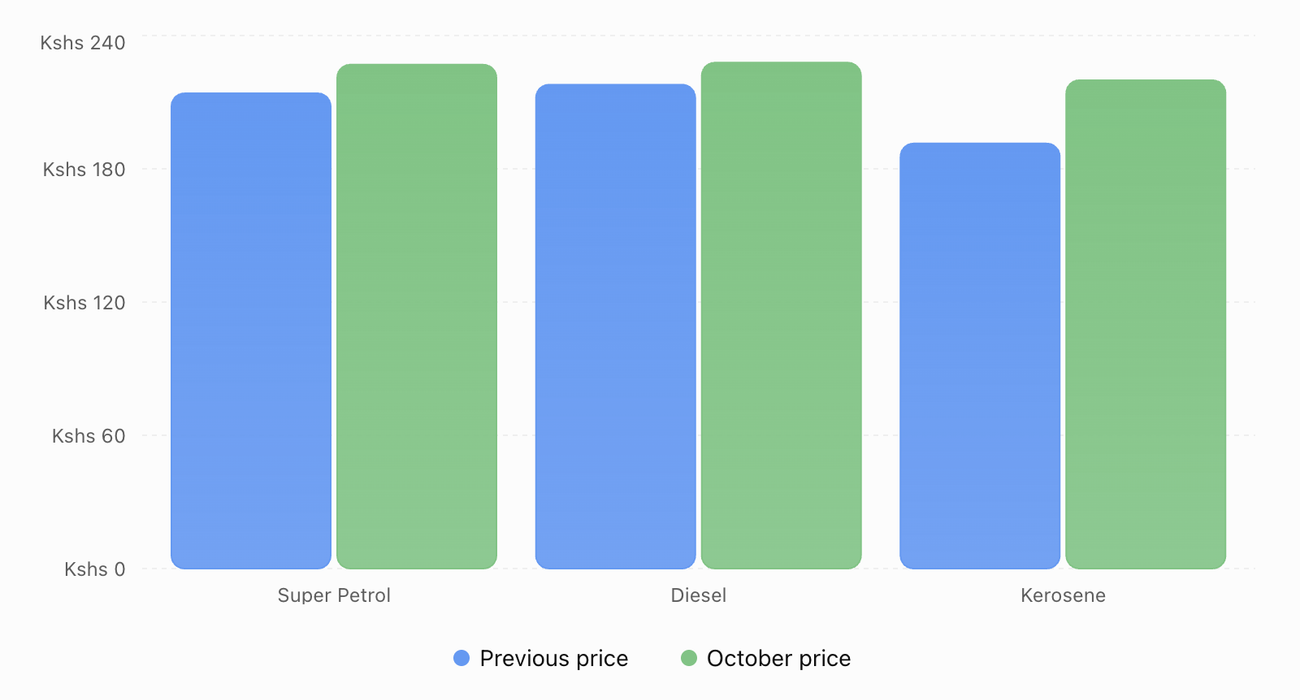
The maximum retail price of Kerosene increased by Kshs 28.5 per litre to Kshs 219.9, while Super Petrol increased by Kshs 12.9 to Kshs 226.9. Diesel prices rose by Kshs 9.9 to Kshs 227.8 per litre.
The increases were primarily attributable to higher international petroleum prices, with average landed costs of imported Super Petrol, Diesel and Kerosene increasing by 11.8%, 11.3% and 9.4%, respectively, in September 2026.
The relatively stable exchange rate helped moderate the impact of rising international petroleum costs. However, Kenya’s reliance on imported refined petroleum products continues to expose domestic consumers and businesses to external energy market volatility.
Outlook: Domestic fuel prices are likely to remain elevated in the near term, with geopolitical tensions in the Middle East presenting a significant upside risk. Sustained increases in petroleum prices could translate into higher transport, manufacturing and distribution costs, reinforcing inflationary pressures and potentially limiting the Central Bank’s flexibility to resume monetary policy easing.
6.2 Kenya Q2’2026 GDP Performance
During the week, the Kenya National Bureau of Statistics released its Q2’2026 Quarterly Gross Domestic Product Report, indicating that the Kenyan economy expanded by 5.1% compared to 4.9% recorded in Q2’2025.
The expansion reflected continued resilience across several sectors despite heightened global uncertainty, elevated energy prices and adverse weather conditions affecting agricultural production.
- GDP growth: 5.1% (Q2’2026)
- Agriculture: 3.5% (Sector growth)
- Electricity & water: 7.7% (Sector growth)
Agriculture, Forestry and Fishing
The agricultural sector expanded by 3.5% in Q2’2026, compared to 4.0% in Q2’2025. Its contribution to GDP declined slightly to 19.3% from 19.6%, although it remained the economy’s largest sector.
The moderation in growth was primarily attributed to the early cessation of the March–May long rains, which adversely affected crop production during critical development stages.
Nevertheless, performance was supported by increased tea production, which rose by 11.1% to 162.6 thousand metric tonnes, alongside a substantial increase in sugarcane deliveries. Coffee exports also increased by 10.0%, while vegetable and cut flower exports recorded improvements.
However, milk intake by processors declined by 3.1%, while fruit exports contracted by 5.8%, highlighting the uneven impact of weather conditions across agricultural activities.
Electricity and Water Supply
The electricity and water supply sector recorded growth of 7.7%, compared to 6.5% in Q2’2025, supported by increased electricity generation from renewable sources and reduced reliance on thermal generation.
Geothermal electricity generation increased by 10.1%, wind generation rose by 13.5%, and hydroelectric generation also expanded. Conversely, thermal generation declined by 16.3%, reflecting reduced reliance on comparatively expensive thermal power.
The continued expansion of renewable electricity generation remains positive for Kenya’s long-term energy security, potentially reducing exposure to international petroleum price volatility and supporting industrial competitiveness.
Accommodation and Food Services
The accommodation and food services sector expanded by 7.4%, compared to 12.8% in Q2’2025. Despite the moderation, the sector’s contribution to GDP increased to 1.8% from 1.6%.
International visitor arrivals through Jomo Kenyatta International Airport and Moi International Airport increased by 1.4% to 424,220 visitors from 418,193 recorded in Q2’2025.
The performance indicates continued growth in tourism-related activity, although the slower expansion suggests that external uncertainties and travel-related costs may be moderating demand.
Economic Outlook
Kenya’s economy continues to demonstrate resilience despite heightened external uncertainties. The 5.1% GDP growth recorded in Q2’2026 highlights the contribution of domestic economic activity, particularly in electricity generation, tourism-related services and information and communication.
Nevertheless, inflationary pressures remain a significant concern. Annual inflation increased to 6.8% in September 2026 from 6.6% in August, remaining above the midpoint of the Central Bank’s target range of 2.5%–7.5%.
The combination of elevated international energy prices, weather-related agricultural disruptions and a widening current account deficit continues to present downside risks to economic growth.
Against this backdrop, the Central Bank maintained its policy rate at 8.75% in October 2026, reflecting a cautious monetary policy stance aimed at anchoring inflation expectations and preserving exchange rate stability.
Looking ahead, Kenya’s economic growth is projected within the range of 4.4%–5.3% in 2026, supported by resilient domestic fundamentals, improved private sector credit growth and relatively stable foreign exchange conditions. However, sustained geopolitical uncertainty and elevated energy costs could constrain growth and delay further monetary policy easing.
7. Fixed Income Market Outlook
Kenya’s fixed income market continues to attract significant investor demand, as demonstrated by sustained Treasury Bill oversubscription and strong participation in longer-dated Treasury Bond auctions.
The prevailing market environment is characterized by relatively stable short-term yields, attractive nominal returns on longer-dated securities and increased caution regarding the future direction of inflation and monetary policy.
The strong demand for the 91-day Treasury Bill indicates that many investors continue to prioritize liquidity and flexibility. At the same time, the substantial subscription levels recorded in the longer-dated bond auction suggest continued appetite among investors seeking to lock in higher yields over extended investment horizons.
Going forward, we expect the fixed income market to be shaped by three principal factors: the trajectory of inflation, the government’s domestic borrowing requirements and the Central Bank’s monetary policy stance.
With inflation remaining elevated at 6.8% and international petroleum prices increasing, the likelihood of an immediate resumption of monetary policy easing appears limited. Consequently, short-term interest rates may remain relatively stable, while medium- and long-term bond yields could continue to reflect higher inflation and duration risk premiums.
We expect investors to maintain a selective approach, balancing the attractive returns available on longer-dated securities against the flexibility offered by shorter-term instruments.
Overall, our outlook for Kenya’s fixed income market remains cautiously positive, supported by sustained investor demand and relatively stable domestic financial conditions. However, elevated inflation, geopolitical uncertainty and government borrowing requirements are likely to remain important determinants of yields and investor positioning over the coming months.
Editorial note: This report is prepared from the figures supplied for the week ending 16 October 2026. Before publication, reconcile the Treasury Bill auction totals (Kshs 68.5 bn at 244.6% implies approximately Kshs 28.0 bn offered), the basis-point changes reported alongside rounded yields, and the bond tax-equivalent yield calculations, which appear inconsistent with the stated 10% and 15% withholding rates. The reported real returns are simple nominal yield-minus-inflation spreads rather than compounded real yields. The attribution of the exceptional Treasury Bill demand to investor preferences and the forward-looking market outlook are analytical interpretations.